DECISIONS · SYSTEMS · AI
Complex models become workflows people trust.
From financial models to production AI, I build products and decision frameworks that help people make better decisions in complex systems.

Now
A snapshot of what I’m currently building, reading, and thinking about.
Updated July 2026
Watching
Reading
Building
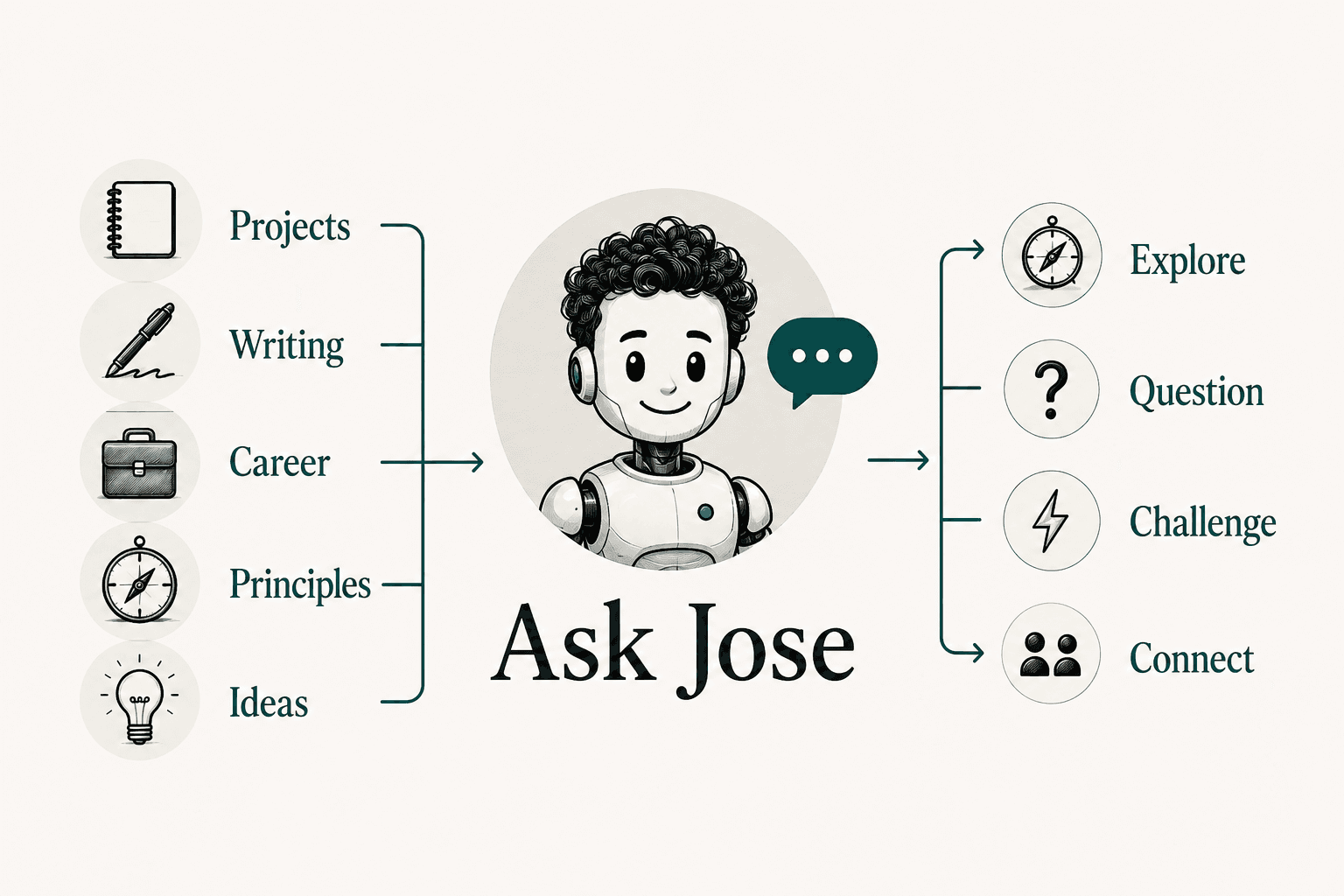
Ask Jose
Hey — glad you’re here.
I can help you explore how Jose thinks about AI products, decision systems, trust, adoption, and the work behind this site.
Start here
How I Operate
The principles that shape how I build products, make decisions, and work with others.
These are not abstract values or rules I always follow perfectly. They are the standards I return to when the problem is unclear, the tradeoffs are real, or the path forward is uncomfortable.
I have always been uncomfortable repeating an explanation simply because it came from someone more experienced, more technical, or more senior.
Before I can make a good decision, I need to develop my own mental model of the problem.
That means understanding the incentives, constraints, dependencies, and assumptions shaping the system. It means asking what must be true, what could fail, and which parts of the explanation are evidence versus convention.
This does not mean ignoring expertise. It means using expertise as an input rather than a substitute for judgment.
Whether I am evaluating a company, designing a lending workflow, or working with a machine learning model, I want to understand enough of the underlying system to know where the real leverage and risk reside.
In practice
Understanding the system around the business
While covering regulated utilities and corporate debt in Argentina, the financial statements alone were never enough.
Understanding companies such as Transener required understanding the regulatory framework, inflation, political incentives, currency restrictions, capital expenditure needs, and the government’s ability and willingness to adjust tariffs.
The investment thesis existed inside the system surrounding the company, not only inside the company itself.
Understanding why the models worked
At Zest AI, it was not enough to know that a machine learning model outperformed an existing underwriting approach.
To help customers trust and adopt it, I needed to understand where the performance improvement came from, how the model behaved across different populations, and where customers would still need safeguards or human judgment.
That understanding allowed me to translate technical confidence into decisions customers could act on.
Good decisions begin with an explanation you genuinely understand.
Many disagreements that appear philosophical are really disagreements about assumptions, priorities, or acceptable risk.
Quantification helps make those differences visible.
Whenever possible, I translate intuition into models, assumptions into explicit variables, and competing objectives into measurable outcomes.
The goal is not to eliminate judgment. Models are always incomplete, and the most important questions are rarely answered by a single metric.
The goal is to create a shared representation of the decision so people can understand what they are choosing, what they are giving up, and what would need to change for the answer to be different.
Quantification is not the goal.
Better decisions are.
In practice
Modeling the economics of lending decisions
When lenders considered changing an underwriting policy, the decision was not simply whether one approach produced a better model score.
The real question involved approval volume, expected losses, operational capacity, customer experience, and risk appetite.
By making those relationships visible, teams could move beyond vague preferences and evaluate the economic consequences of different policies.
Making an entire market comparable
At TPCG, I helped produce a corporate strategy report covering Argentina’s major corporate bond issuers.
The work required translating companies across industries into a consistent framework that investors could use to compare leverage, cash generation, currency exposure, regulation, and downside risk.
The value was not the spreadsheet itself. It was making the reasoning behind each recommendation visible and comparable.
Good models do not merely produce answers. They expose the reasoning behind them.
Products accumulate complexity quickly.
A new rule, feature, dashboard, approval step, or automation may solve an immediate problem while quietly making the broader system harder to understand and operate.
I try to resist that drift.
Before building, I ask what behavior the intervention is meant to change, which constraint it removes, and what new failure modes it may introduce.
Sometimes the right answer is automation. Sometimes it is a clearer interface, a better decision boundary, or a deliberate point where the system should stop and ask for human judgment.
Intentional design means understanding not only what a product can do, but what it should do, what it should not do, and why.
In practice
Designing a deliberate boundary for human judgment
In credit underwriting, certain situations carried risks that were not well represented by the model alone.
Rather than treating automation as the objective, we designed guardrails that identified cases—such as certain bankruptcy scenarios—where the system should stop and route the decision for additional review.
The goal was not maximum automation.
It was a better allocation of machine and human judgment.
Designing friction for meaning
Record Library began with a simple question: what changes when listening to music is no longer effortless and infinite?
Instead of recreating a streaming service, I limited the experience to a small collection of albums and required users to engage with them more deliberately.
The friction was not an inconvenience to remove. It was part of the product’s purpose.
The best design choices are often decisions about what not to automate, add, or accelerate.
A technically superior solution can still fail if it asks people to abandon familiar behaviors without giving them enough confidence, clarity, or control.
This is especially true when the product affects consequential decisions.
People need to understand what is changing, why the new approach is better, where its limits are, and what role they still play inside the system.
That requires more than user research at the beginning of a project.
It requires continuing to observe how people interpret the product, where they hesitate, what they work around, and what they believe the product is asking them to give up.
Adoption is not the final step after a product is built.
It is part of the product.
In practice
Helping lenders trust a new way of deciding
At Zest AI, the greatest challenge was not simply building accurate machine learning models.
It was helping lenders trust and adopt them.
For more than fifty years, credit underwriting had relied on familiar processes, established rules, and human intuition. Asking lenders to use machine learning meant changing not only a tool, but how people understood and took responsibility for decisions.
Successful adoption required transparency, staged rollout, clear guardrails, and tools that let customers explore how the model behaved before they expanded its authority.
Finding the real adoption barrier
Customers sometimes asked for additional rules because rules made the system feel safer.
But more rules did not always improve the outcome. In some cases, they limited automation without adding meaningful predictive value.
The product challenge was not to accept the request literally. It was to understand the fear underneath it and provide another path to confidence.
People rarely resist technology itself. They resist uncertainty, loss of control, and change they do not yet trust.
Many product failures begin long before execution.
They begin when different teams use the same words to mean different things, optimize for different outcomes, or carry incompatible assumptions about how the system works.
I often find myself working between disciplines: finance and data science, customers and engineers, technical performance and business outcomes.
My role is not simply to translate vocabulary.
It is to help people build a shared model of the problem, the tradeoffs, and the decision being made.
Once that shared understanding exists, alignment becomes easier. Teams can disagree more precisely, identify the true source of conflict, and move forward without pretending that ambiguity has disappeared.
In practice
Bridging finance and data science
Lending Intelligence connected model outputs with concepts such as expected loss, portfolio performance, and CECL.
The product challenge was not merely displaying technical metrics. It was representing model behavior in a language financial institutions already used to manage portfolios and make decisions.
That shared framework helped technical and financial stakeholders reason about the same underlying system.
Making Argentina legible to global investors
International investors evaluating Argentina needed more than company information.
They needed a framework for understanding inflation, regulation, political change, currency controls, and sovereign risk—and how those forces affected individual businesses.
My work was to translate that complexity into a decision framework investors could evaluate, challenge, and use.
Alignment does not come from repeating the same conclusion. It comes from understanding the problem together.
Journey
From understanding markets to designing systems that improve judgment.
Every stage of my career added a different way of thinking. Business Economics gave me a foundation in incentives and value creation. Finance and investing taught me to make decisions under uncertainty and separate signal from noise. Product taught me that technology succeeds only when people trust it. Today, I build AI products by combining those perspectives into systems that help organizations make better decisions.
The thread
Helping people make better decisions in complex systems.
2005–2014
Learning to Think in Models
Context
Universidad Torcuato Di Tella (B.A. in Business Economics • M.S. in Finance) • RSH Macroeconomía
Economics taught me to think in incentives. Finance taught me to quantify uncertainty. Software taught me leverage.
My career began with a fascination for understanding how businesses, markets, and institutions work.
After completing a B.A. in Business Economics at Universidad Torcuato Di Tella, I earned an M.S. in Finance there as well. My thesis explored real options valuation—a framework for making decisions under uncertainty by recognizing the value of flexibility. Long before I entered product management, this reinforced a principle that still shapes my thinking today: every meaningful decision involves tradeoffs.
I then worked in economic consulting, analyzing policy and building financial models for governments and private-sector clients. I quickly began writing software to automate repetitive analyses and reports, discovering that technology could amplify understanding rather than simply save time.
Those early years taught me to think beyond individual companies. Markets became systems of incentives, expectations, and human behavior. I realized that understanding those systems was often more valuable than simply memorizing financial metrics.
Understanding systems is often more valuable than memorizing facts.
Added
- Systems Thinking
- Incentives
- Tradeoffs
- Leverage
2014–2017
Learning to Invest Under Uncertainty
Context
Supporting Bank of America Merrill Lynch teams • TPCG
Investing taught me to evaluate businesses, separate signal from noise, and translate uncertainty into decisions.
I supported Bank of America Merrill Lynch investment-banking teams through analytical and financial-modeling work—not as a Bank of America employee, but embedded with the team. That included extended periods in New York working alongside them. Through that collaboration, I learned high-yield credit analysis from one of the industry’s leading institutional investment groups before transitioning into equity research. I developed the discipline of evaluating businesses through both quantitative analysis and qualitative judgment.
Later, I joined TPCG, where I was given responsibility for my own coverage of Argentina’s regulated utilities and corporate debt markets.
The work extended far beyond valuation.
I helped international investors understand one of the world’s most complex investment environments—combining inflation, currency controls, regulation, sovereign risk, and political change into investment frameworks that clients could actually use.
During this time, I covered some of Argentina’s earliest renewable energy issuances, including Genneia, as the country began attracting new investment under a changing regulatory environment. I also followed companies such as Transener, where combining regulatory analysis with business fundamentals led to recommendations that generated returns exceeding 200%.
The experience taught me that people rarely struggle because they lack information.
They struggle because they need a way to organize complexity into decisions they can confidently make.
People rarely struggle because they lack information. They struggle because they need a way to organize complexity into decisions.
Added
- Judgment
- Uncertainty
- Signal vs. Noise
- Business Analysis
2017–2025
Learning to Build Products
Context
Duke University (MBA) • Zest AI
Business school brought me into startups. Zest AI taught me that building AI products is ultimately about earning trust.
I came to the United States to attend Duke University’s Fuqua School of Business because I wanted to move from analyzing businesses to building them.
After graduating, I joined Zest AI, then a rapidly growing startup helping financial institutions adopt machine learning for credit underwriting.
This was years before generative AI made conversations about explainability and black-box models mainstream.
Our challenge wasn’t simply building accurate models.
We were asking lenders to rethink workflows that had remained largely unchanged for more than fifty years.
Success depended on helping organizations trust AI—not simply deploy it.
I began on the customer-facing side of the business, helping lenders operationalize machine learning inside highly regulated environments. Working closely with customers gave me a front-row seat to the organizational, technical, and human challenges of AI adoption.
As the company matured, I transitioned into Product Management.
Over the following years I helped launch and expand products across the lending lifecycle, including internal AI tools, Lending Intelligence, policy simulation capabilities, workflow improvements, and governance features that balanced automation with human oversight.
Many of the ideas that now define how I think about product emerged during this period.
The most successful AI products weren’t necessarily those with the smartest models.
They were the ones that improved judgment, created trust, and fit naturally into how organizations actually made decisions.
The best AI products improve judgment, create trust, and fit naturally into how organizations actually make decisions.
Added
- Trust
- Product Strategy
- Workflow Design
- Operational AI
2025–Present
Building My Own Convictions
Context
Independent • Compass • RecordLibrary • Writing • AI Systems
Stepping away from a company gave me the opportunity to clarify what had connected every stage of my career.
After Zest AI’s exit event and my departure from the company, I decided not to immediately jump into another role.
Instead, I took time to reflect on the work I had found most meaningful.
Across consulting, investing, and AI, I realized I had been solving the same problem from different angles:
How do we help people make better decisions in complex systems?
That realization became the foundation for the projects I’m building today.
Compass explores structured reflection, helping people think more deliberately about their goals, decisions, and personal growth.
Record Library encourages a more intentional relationship with music by introducing thoughtful friction into an experience typically optimized for speed and endless consumption.
At the same time, I’ve been writing about product judgment, AI adoption, decision design, organizational trust, and the role technology should play in improving—not replacing—human thinking.
These projects are different from the enterprise software I’ve built professionally.
But they all pursue the same idea.
Technology creates the greatest value when it helps people better understand complexity, exercise better judgment, and act with greater confidence.
Added
- Reflection
- Independent Building
- Product Philosophy
- Human-Centered AI
Looking Ahead
I’m interested in opportunities at the intersection of AI, product, and organizational decision-making.
The technologies will continue to evolve. The underlying challenge will remain the same: designing systems that help people make better decisions.